Anime at VIDEO ICHIBAN

Homer gets Fugu-ed

“One Fish, Two Fish, Blowfish, Blue Fish” is the eleventh episode of The Simpsons’ second season. The episode aired on January 24, 1991.

[Fugu] contains lethal amounts of the poison tetrodotoxin in the internal organs, especially the liver and gonads, and also the skin. Therefore, only specially licensed chefs are allowed to prepare and sell fugu to the public, and the consumption of the liver and ovaries is forbidden. However, a number of people die every year from consuming improperly prepared fugu.

Karaoke (カラオケ, Karaoke from kara, “empty” or “void”, and ōkesutora, “orchestra”) is a form of entertainment in which amateur singers sing along with recorded music using a microphone and a PA system. The music is typically a well-known pop song in which the voice of the original singer is removed or reduced in volume.

Homer Simpson Sparkles as Mr. Sparkle

After church Homer [Simpson] takes Bart and Lisa to the Springfield dump, where they find a box of Japanese dishwasher detergent known as Mr. Sparkle. The face on the box of detergent greatly resembles Homer. Homer, disturbed by the box of Mr. Sparkle, contacts the manufacturer in Japan for information. He is sent a promotional video for Mr. Sparkle, which consists of a bizarre TV commercial. At the end of the video, the mascot is shown to be a result of a joint venture between two large Japanese conglomerates whose mascots, a fish and light bulb, merge together to form Mr. Sparkle.

Tom and Jerry Pack Top Lady For Hitachi

Hitachi was founded in 1910 as an electrical repair shop. Today it is one of the leading retailers in new technology.

Kuroyanagi Tetsuko (Japanese language: 黒柳徹子), born August 9, 1933 in Tokyo) is a well-known Japanese TV personality.

Due to its lack of dialog, Tom and Jerry was easily translated into various foreign languages. Tom and Jerry began broadcast in Japan in 1964. A 2005 nationwide survey taken in Japan by TV Asahi, sampling age groups from teenagers to adults in their sixties, in 2005 ranked Tom and Jerry #85 in a list of the top 100 anime of all time, while their web poll taken after the airing of the list ranked it at #58 – the only non-Japanese animation on the list (it should be noted that in Japan, the word “anime” refers to all animation regardless of origin, not just Japanese animation).

The Simpsons Towel Up For CC Lemon

C.C. Lemon is a Japanese soft drink created by Suntory. It is the third most popular soft drink in Japan behind Coca-Cola and Pepsi. It is known for its lemony taste and for its commercial advertisements featuring characters from the popular American cartoon The Simpsons.

A towel can act as a make-shift garment or blanket. There is a variety of uses when a towel is applied in this manner. For example, the towel can be used as an extra layer of clothing for cold conditions; or can be worn on its own around the waist (similarly to a kilt or skirt) or just under the shoulders (similarly to a long dress), usually in a warm environment.

Namco Debias Lupin III Side Pocket

Namco Ltd (株式会社ナムコ, Kabushiki Gaisha Namuko) is a company based in Japan, best known for developing video games. Some of the company’s most famous games include Galaxian, Pac-Man, Klonoa, Rally-X, Galaga, Bosconian, Dig Dug, Pole Position, Xevious, Mappy, Soul Calibur, Time Crisis, Tekken, and the Ridge Racer. As of September 29, 2005, Namco was merged with leading Japanese toymaker Bandai to form Namco Bandai Holdings Inc, one of the largest entertainment companies in Japan.

Lupin the 3rd (ルパン三世, Rupan Sansei) is a manga and anime series created by Kazuhiko Kato in 1967. The series follows a gang of thieves, led by Arsène Lupin III, as they steal treasures and escape from the law.

Speed Racer Opening Song

Speed Racer is the title of an English adaptation of the Japanese anime Mach Go Go Go ([マッハ・ゴー・ゴー・ゴー)]which centered around automobile racing. The series is an early example of an anime becoming a successful franchise in the United States.

Saturday Night Live TV Funhouse Kobayashi

[Takeru] Kobayashi has won Nathan’s Hot Dog Eating Contest for six years in a row.

    2006: 53 3⁄4 hot dogs
    2005: 49 hot dogs
    2004: 53 1⁄2 hot dogs
    2003: 44 1⁄2 hot dogs
    2002: 50 1⁄2 hot dogs
    2001: 50 hot dogs

Dragon Ball Z (ドラゴンボールZ, Doragon Bōru Zetto) is the adaptation of the second portion of the immensely popular Dragon Ball manga written and drawn by Akira Toriyama, this makes it the sequel to the Dragon Ball anime. It was initially released in Japan and Hong Kong, and later elsewhere in the world including the United States. The ‘Z’ was originally added to the title by Toriyama to signify it as being the ending portion of the Dragon Ball series.

TV Funhouse is the title of a recurring skit on NBC’s Saturday Night Live featuring cartoons created by longtime SNL writer Robert Smigel, as well as a short-lived spinoff series that ran on Comedy Central.

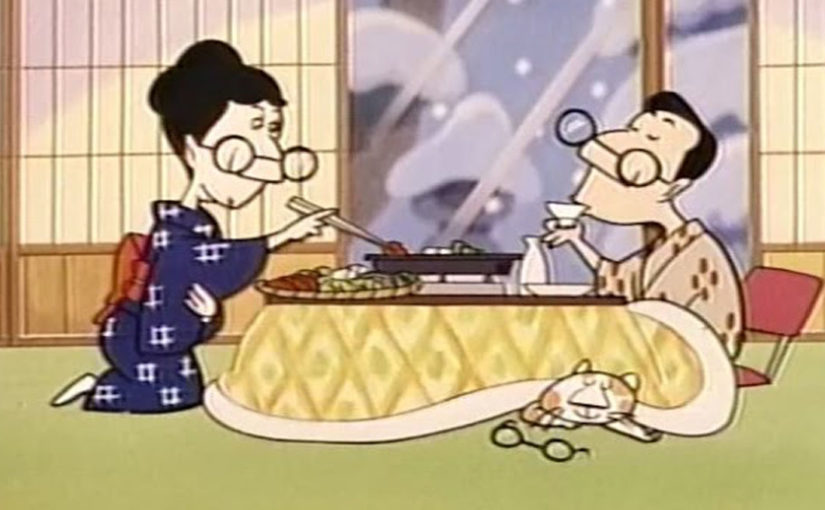
Kizakura Sake (1959)

Sake (Japanese: 酒) is a Japanese word meaning “alcoholic beverage”, which in English has come to refer to a specific alcoholic beverage brewed mainly from rice, and known in Japan as either nihonshu (日本酒 “Japanese alcohol”) or sake. This article uses the word “sake” as it is used in English.

Kappa (河童, Kappa “river-child”), alternately called Gatarō (川太郎, Gatarō “river-boy”) or Kawako (川子, Kawako “river-girl”) , are legendary creatures; a type of water imp found in Japanese folklore. However they are also considered to be a part of cryptozoology, due to apparent sightings. In Shintoism they are considered to be one of many suijin (literally “water-deity”).

Crayon Shinchan Goes Cherry Blossom Viewing

Crayon Shin-chan (クレヨンしんちゃん, Kureyon Shinchan) is a manga and anime series written by Yoshito Usui. The American version of the manga is titled “Crayon ShinChan” while the UK, Catalan, Spanish, Portuguese, Dutch, German, Hindi and American version of the anime is titled Shin-Chan. The series follows the antics of a five year-old boy Shinnosuke Nohara, his parents, neighbours and friends. This story is set in Kasukabe, Saitama Prefecture, Japan. The show is called “Crayon Shin-chan” because “crayon” signifies the fact that it is a tool commonly used by kindergartners and that Shin-chan goes to kindergarten. “Shin-chan” is the affectionate name for the main character.

Hanami (花見, Hanami, lit. “flower viewing”) is the Japanese traditional custom of enjoying the beauty of flowers, “flower” in this case almost always meaning cherry blossoms (桜 or 櫻, sakura), or ume blossoms (梅, ume). From late March to early April (early May on Hokkaidō), sakura bloom all over Japan. The blossom forecast (桜前線, sakurazensen, lit. cherry blossom front) is announced each year by the weather bureau, and is watched carefully by those planning hanami as the blossoms only last a week. In modern-day Japan, hanami mostly consists of having an outdoor party beneath the sakura during daytime or at night. Hanami at night is called yozakura (lit. “night sakura”). In many places such as Ueno Park temporary paper lanterns are hung for the purpose of yozakura.

Kizakura Sake (1961)

Sake (Japanese: 酒) is a Japanese word meaning “alcoholic beverage”, which in English has come to refer to a specific alcoholic beverage brewed mainly from rice, and known in Japan as either nihonshu (日本酒 “Japanese alcohol”) or sake. This article uses the word “sake” as it is used in English.

Kappa (河童, Kappa “river-child”), alternately called Gatarō (川太郎, Gatarō “river-boy”) or Kawako (川子, Kawako “river-girl”) , are legendary creatures; a type of water imp found in Japanese folklore. However they are also considered to be a part of cryptozoology, due to apparent sightings. In Shintoism they are considered to be one of many suijin (literally “water-deity”).

Google